Friday, October 3, 2014

East India Company, Communal Pujas and Mishti Inventors of Bengal 

Bengali Hindu households respond to the Mayer Dak as Durga Puja arrives in all its splendor,  as we prepare for this autumn festival of welcoming the mother home. An amalgamation of cross cultural cuisines and religious traditions which came as a result of Bengal’s active participation in the structure of the history of India, Durga Puja was celebrated inside the homes of people, in their own simple ways with the fervor of a devotee. Yet, today we enjoy it as a more large scale event.


Nobin Das was no inventor. At least he didn’t mean to become one until he learnt the complex art of making a cheese dessert or chhana from Orissa and tried to recreate it back home in Kolkata, in 1868. But the journey had been a long one and Mr. Das was a believer of saving time, so instead he invented what soon became the most popular dessert out of Bengal: the revered Sponge Roshogolla. This was around the time when the Durga Pujas had also become a lively festival, where the British leant their glamour quotient as honored guests and the hosts considered this a mark of their status.


Apparently one of the first recorded mass celebrations of Durga Puja happened in Malda and Dinajpur in the 16th century. Patronized by the Nawabs of that era, 6 zamindars of Nadia, Burdwan, Natore, Dinajpur, Birbhum, and Bisnupur were given the privilege to display their wealth, fervour and share the joy with their communities. As much as these 6 zamindars contributed towards unifying the Hindu community while maintaining a relationship of religious tolerance with the ruling Nawabs, Raja Nabakrishna Deb, founder of the Shovbazar Raj family in Kolkata celebrated the decline of the Muslim rule at the hands of Robert Clive. After the battle of Plassey and Nawab Siraj-ud-Daulah’s crushing defeat, in 1757 the Munshi or clerk to Warren Hastings, Nabakrishna offered his own home and the deity of goddess Durga to Robert Clive, for thanksgiving.  The famous nautch girl Nikki Bai was invited and amidst the ham consumed and the alcohol drunk, all religious intentions more or less dwindled and from then onwards, many Hindus of Kolkata considered it a privilege to invite the British over for Durga Puja festivities. They even went as far as to fashion the mother goddess statues to look more like Queen Victoria. The British encouraged this show of fervor till the 1840, after which they totally banned it. So much for religious harmony! Yet, as upstarts like Nabakrishna took the opportunity of his job and his position to make a lavish affair of a simplistic religious ritual, the Barowari (12 friends) of Guptipara are responsible for making this a group or communal festival in 1790. This could also be as a result of the Cornwallis agreement where zamindars could not extract tax from their tenants anymore which led to the Barowari chipping in from the community members. The Barowari tradition later culminated into Sarbajanin Durga Puja in 1910, or an “all inclusive” festival and Durga Puja became what we know it as today.


In Bangladesh, the family of R P Shaha of the Kumudini Welfare trust in Mirzapore, Tangail still host the most organized and festive of pujas in the country. With the students of the Bateshwari Homes volunteering to serve the guests, Hindus from the neighbouring areas, guests from all over the country and patrons of the trust all gather to participate in the Sarbojanin Puja. The vegetable mix or niramish served with rice and chholar daal, cooked in the customary fashion with coconut, is often followed by malpoa as a dessert (or at least on the 9th day or nabammi when yours truly went).

The famous zamindar family of Muktagacha in Mymensingh, the Chowdhurys, always held the best pujas. Rani Bimola Devi of the Chowdhury family built a twin Shiva temple where Durga Puja was also celebrated as a Sarbojanin affair. The Chowdhurys welcomed everyone and today their legacy lives on through another one of Bangladesh’s most famous desserts, the famous Monda of Muktagacha. Mr. Gopal Pal enjoyed the privileges of being the official sweetmeat maker of the zamindar, after he presented Raja Chowdhury with this unique creation of his in 1824. Today, his shop is still operating and run by his great grand children.


So as dashami draws near and Hindus far and wide prepare for the final leg of festivities and bidding their mother goddess a teary farewell, we pay homage to the course of events that led to this once homebound tradition to become a public one, that brings people of all religions and sects closer, through music, the art work of the goddess statues and above all, food! 


(This article of mine was printed in the Dhaka Tribune's Weekend Magazine called Weekend Tribune:
http://www.dhakatribune.com/sites/default/files/issue/2014/10/Weekend%202%EF%80%A221.pdf)

Sunday, September 28, 2014

Nalanda University: On the trail of Hiuen Tsang and Ashoka the great

My sister and I were on a quest to follow the trail of Ashoka the Great and the modest, docile monk Hiuen Tsang. Ashoka for my sister, Tsang for me and we figured out plan of action where both these men had traversed each other’s pathways. Our reference book was “Ashoka: The Search for India’s Lost Emperor” by Charles Allen and my sister booked me a ticket to join her in Kolkata and hence we were off to Bihar by the night train.

Nalanda University was built during the Gupta period of the 5th century CE (Current Era)and retained its high standards of education up until the 1100s, when it was plundered and left in ruins, by the Mamluk Mohammed Khilji' men. Tsang had travelled across China from Xian, crossing the Gobi desert, the Tian Shan and the Amu Darya, Uzbekistan, through Afghanistan and Pakistan to reach Bihar. He took 3 years to arrive at Nalanda, having won hearts along the way as kings of various states all bowed down to his wisdom and offered him help.


At Nalanda, Tsang gained more popularity and today it is because of him that Sir Alexander Cunningham, the chief archeologist of the British, excavated some of the most important sites of Buddhist history, and Ashokan history. Tsang's travelogue helped the archaeologist locate the lost relics of Buddhist and Indian history, so in my eyes, Tsang is one of the biggest preservers of our history. 
Now I had been watching a documentary in Chinese with English subs on Tsang and the narrator kept pronouncing it as “Naalundaa” so  throughout the 2 hour car ride I kept bugging my sister with an elongated stretch of “Oooh look appa Naalundaa is still quite far..!” We got lost, our driver tried acting smart and took all the wrong turns but we finally arrived and I had to go into zen mode to stop myself from hurtling down the long path to the entrance of ancient Nalanda and throw myself on the red bricks, sobbing with delight! Ahem.. I took measured steps and we first visited the museum as it was midday so we decided to cool our heels before entering the main university campus. The shops lining both the entrance way to the Nalanda and the museum were highly distracting and the loud, raucous religious songs playing which sounded like raunchy quacks in that heat were a serious disturbance. Inside the museum we even saw a mandate on Responsible Tourism by Bihar tourism board which stated “avoid buying from shops close to archaeological site as it will promote more shops from being set up” Ironic!
Museum done and my level of anticipation about to reduce me to a bawling fit, my sister downed two glasses of Zeera paani (she even drank mine!) and we finally entered the Nalanda premises. 


A long walk to the entrance was flanked by massive gardens on either side and the red brick structure began with an introductory plaque. Once inside, I wasn’t in 2014 anymore.

Mahavihara is the name given to a Great Learning Centre and in the times of the Gupta dynasty ( 320-550 CE), Nalanda is said to have been at its best. With no expenses spared, the state supported an education system that would not only teach young Buddhist monks about subjects like Metaphysics, Grammar, Theology and Science, but also Logic, which led to a healthy tradition of open debates amongst the students. The vast, lush gardens were the site of much debate or quiet contemplation, as the monks took refuge under the massive trees. The University could accommodate over 10,000 students and 2,000 teachers, with an average of 3,000 and 5,000 students at any time. The architecture of the university was considered for many centuries as a masterpiece. It had eight separate compounds and ten temples, along with many other meditation halls and classrooms and a library that is said to have been 9 storeys high! The grounds constituted of lakes and parks and the main complex was built with red bricks and its ruins occupy an area of 14 hectares.

Plaque at the entrance explaining the history

passages leading to inner quarters

rooms lined on one end

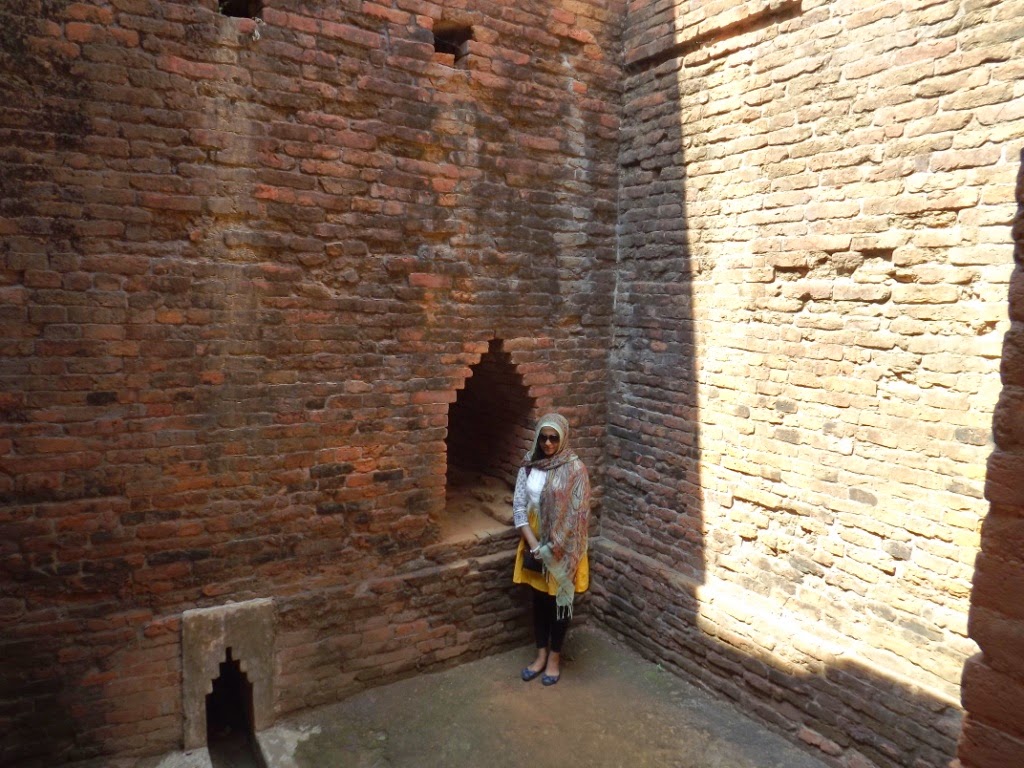
alcoves for lanterns and a drainage system!


We walked from one bricked passage to the other and peered inside alcoves and large openings which were the rooms with a distinct drainage system in place and marveled at the vastness of the place. I imagined my docile Tsang, who was greatly honored by the celebrated teacher Shailabhadra, who is said to be well conversed in the mnay forms of Buddhism that were in practice in those days as well as languages like Pali. Shailabhadra had dreamt of a star pupil who would arrive to him from China so when Tsang came, he was given VIP treatment. In his yellow robes that were tied like a loin cloth around the waist and hung just below the knees, Tsang was given betel nuts, nutmegs, rice (long grained and aromatic, possibly Basmati?? But apparently they were only grown in Bihar) and some vegetable provided by the locals, where the university which owned about 200 such villages. I passed a passage and could see my submissive monk walking along it deep in thought, trying to understand the wisdom of the gospels of Buddha, while younger monks went about quietly only to break into a run once outside or twitter at a joke and stifle their laughter everytime they saw a high abbot. 

Only a solitary pose when all I wanted was to STAY there!

the main complex area. The plaque says temple area but I read in some sources it was the 9 storied library!

yours truly ;)
And then it turned out that those 2 glasses of zeera paani had after all NOT been enough for my sister and she wished to dive into a barrel full of zeera pani so we slowly made our way back and I left the large gardens and open courtyards, whose walls once rang with the voices of the debaters. The debates were taken so seriously, that challengers at any one given time, is defeated, had to either convert to Buddhism (in case of Hindus), leave the town, forsake their wealth or cut off their tongues!!!! :O As we contemplated all this and cast an eye on the present day visitors, a stray sentence caught my attention unfortunately, where the overzealous guides who had also accosted us at the gate, were bringing in a family of tourists, complete in wedding attire in the 2pm heat of Bihar. The guide was telling them about which scenes and movies had been shot in this site and which actors frequented during shoots. I think that depressed my sister even more than the lack of zeera pani in her system and I stopped at one last raunchy shop and bought some Buddhist DVDs which naturally didn’t work back home in Dhaka!!!

However the good news is that Nalanda has had a rebirth. Like a phoenix, it rose from the ashes left by Khilji’s men and the rubble that Sir Cunningham cleared, to be the new Nalanda University, whose Vice Chancellor is none other than the Nobel laureate Amartya Sen.  

With a supremely high standard of education, Nalanda is again set to become a university to be reckoned with. I truly hope it produces the next genre of thinkers and philosophers, the likes of whom we lost all those centuries ago. 

Saturday, September 27, 2014

Dear all,
This is my first blog against this new background and it really does feel like a new set up. The last time my blog said "archaeologybuff", which was fine, as I AM a buff of that subject. But over the last 2-3 years my interests expanded and I finally brought in a aspect to my focus: food! :D I have been writing this past 1 year on healthy food for the Daily Star newspaper's weekly magazine Lifestyle and have generated quite a deep seated interest in the heritage of food.

I find it fascinating to know that you can define a culture or a people by the kind of food they eat. Now we Bengalis for example, were never really hunter-gatherers as we lived in the most fertile delta that provided us with all we needed. Hence vegetables, even water hyacinths play a major role in our diet as does fish of course. Whereas my mother's side of the family being half Punjabi and half Pathan from Pakistan, had a culture of hunting as well as farming by the river banks of Punjab so their diet is a whole lot more different with bread and meat playing a major role. And so continues my journey of learning about the history of food and so I hope I can keep entertaining you with interesting anecdotes and info :D

As for archaeology... my sister and I were on a quest to look for Ashoka as well as the great traveller monk Hiuen Tsang. I shall update you on that soon as well as other escapades from my commitment to bringing you the best of archaeology, this side of the Ganges :)

Cheers for now and eat healthy!! :D

Zucchini soup with yak cheese and parsely. Slurp!
At Nalanda, the 5th century ancient Indian university the likes of which have never been seen!

Bodh Gaya, Bihar, India. Sublime...